
Business context and challenge
November includes the run-up to and the start of Black Friday and Cyber Monday, the most competitive stretch of the Amazon year. Strong months can still disappoint on profit if advertising and discounting are not controlled.
Reading the comparison
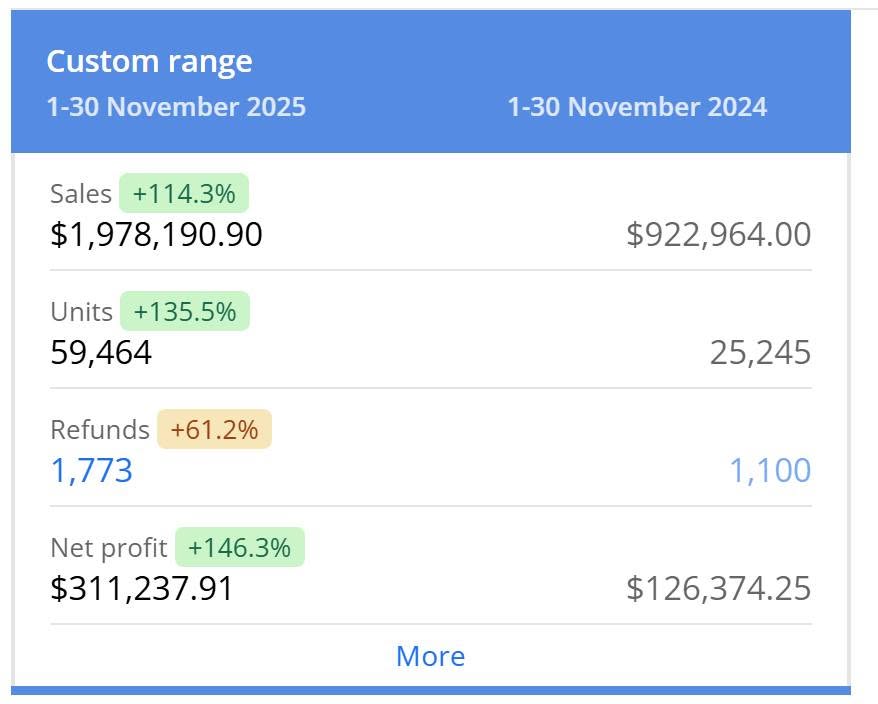
This is a full-month, year-over-year comparison of the same calendar month, so seasonality is broadly matched. Units grew faster than sales (135.5% versus 114.3%), and net profit grew faster than either.
What the report shows
The report records outcomes rather than the individual actions taken during the month, so this case study does not attribute the result to any specific tactic. For the peak-season preparation approach used on a Home & Kitchen account, see the BFCM 2025 case study, whose event window falls within this month.
Results
Sales: $922,964.00 → $1,978,190.90 (+114.3%)
Units: 25,245 → 59,464 (+135.5%)
Refunds: 1,100 → 1,773 (+61.2%)
Net profit: $126,374.25 → $311,237.91 (+146.3%)
What the results indicate
Average revenue per unit fell from about $36.56 to about $33.27, so the growth was driven by volume. Even so, net profit grew faster than sales, which shows the additional volume was profitable rather than bought at the expense of margin.
Results reflect a specific client engagement and reporting period, as shown in the original report. Historical performance does not guarantee future results. Individual outcomes depend on brand, category, economics and execution.