Business context and challenge
Amazon's autumn Prime event is a short, two-day sales window. The question for a brand is how much additional demand it can capture in that window without spending its way out of profit.
Reading the comparison
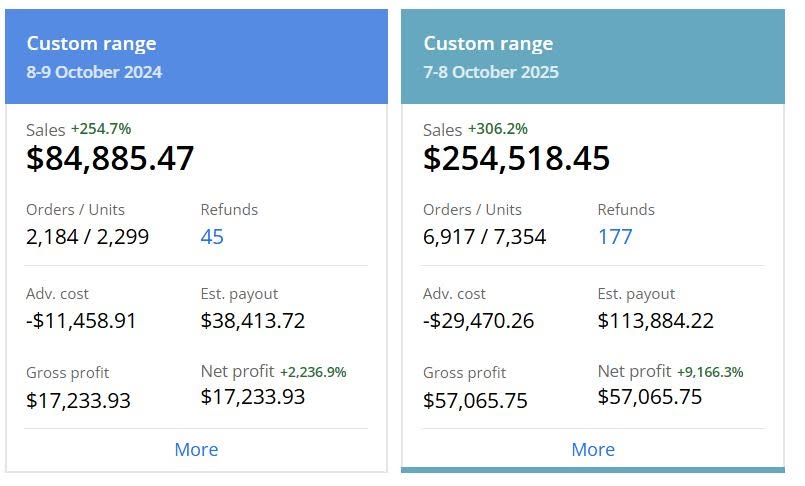
Both periods cover two days, so the comparison is like for like in length. Advertising cost rose 157.2%, from $11,458.91 to $29,470.26. Sales and profit both grew faster than advertising cost, so advertising took a smaller share of revenue in 2025 than in 2024.
What the report does and does not show
The report documents outcomes rather than the individual actions behind them, so this case study does not attribute the result to any specific tactic. It does show that a substantially larger advertising investment was accompanied by an even larger increase in sales and an even larger increase again in net profit.
Results
Two-day sales: $84,885.47 → $254,518.45 (+199.8%)
Orders / units: 2,184 / 2,299 → 6,917 / 7,354 (orders +216.7%)
Advertising cost: $11,458.91 → $29,470.26 (+157.2%)
Net profit: $17,233.93 → $57,065.75 (+231.1%)
Refunds: 45 → 177
What the results indicate
Higher advertising investment is only worthwhile if revenue and profit rise faster than the spend. Here, profit grew the fastest of all three measures. Refunds also rose as volume grew (45 to 177), which is worth tracking after high-volume events.
Results reflect a specific client engagement and reporting period, as shown in the original report. Historical performance does not guarantee future results. Individual outcomes depend on brand, category, economics and execution.